Showing posts with label Experiential Realism. Show all posts

Saturday, February 18, 2017

Some more Inspiration from the Past

The original inspiration for this painting was Claude Monet's, "Women in a Garden". There are three women in his painting, but I was a bit short of women, so this is:

"A Woman, a Dog and a Bird in a Garden", July-Dec, 2016

Oils on canvas, 69.5cm x 49.5cm.


Sunday, March 29, 2015

My most recent paintings!

"Small Skyscape 7", March 2015.
Oils on canvas, 40.5cm x 50.5cm.

"Small Skyscape 6", March 2015, T. Spencer.
Oils on canvas, 40cm x 50.5cm.

"Snowy Slieve Croob Skyscape", February 2015.
Oils on canvas, 49.5cm x 70cm.

"Misty Sunset Skyscape", February 2015.
Oils on canvas, 45cm x 63cm.

"Skyscape near Comber, Co. Down", January 2015.
Oils on canvas, 49.5cm x 69.5cm.

"Mourne View Sunset", January 2015.
Oils on canvas, 49.5cm x 69.5cm.

"Small Skyscape 5", Dec. 2014.
Oils on canvas, 25.5cm x 30.5cm.

Sunday, November 23, 2014

It can take a long time to do a painting!

"View of the Mournes from the Dromara Road, near Ballynahinch, County Down, Northern Ireland", 2014.
Oils on canvas, 50 cm x 70 cm.


The painting was actually started in 2007, when I completed the sky and basic layout. Then I got stuck and left it, just returning to it in the last month. As often happens with me - after I have left it long enough - the final stage is quite straightforward!

Tuesday, November 04, 2014

Recently completed paintings!

Since I have been working in my new studio, I have completed these paintings:


"Welsh Mountainside near Salem, Caernarvon", 2014.
Oils on canvas, 50cm x 40cm.

"Ballygowan Road, near Saintfield, Co. Down, Skyscape", 2014.
Oils on canvas, 25.5cm x 35.5cm.

"Sandy Shore Skyscape", November 2014.
Oils on canvas, 22.5cm x 30cm.

Monday, October 28, 2013

New painting!

"Renewal, Market Square East, Lisburn, N. Ireland", June-Oct 2013.
Oils on canvas, 50cm x 70cm.

The painting shows an area of Lisburn from just outside the door to the studios in Lisburn. I worked on this from observation, approximately for two or three hours, three times a week, over the summer. It took a long time to do because of the detail, which I felt was important for this painting.

Because of the depression, many businesses in Lisburn have been experiencing difficult times, reflected in the number of empty commercial premises to the right. But the city has also been going through a process of renewal. Bridge Street, the road straight ahead, was falling into dereliction, but has now had many of its buildings renovated. As demonstrated by the posters, the city has been making considerable efforts to promote itself. However, that was not really why I particularly wanted to do this painting. I am interested in the nature of reality and painting from observation represents a conversation between myself and the subject being observed.

The most common remark I had from onlookers was that the painting was beautiful, that it was just like a photograph! But that misses the point! What is important is why the painting is NOT like a photograph - because of the distortions that crept in quite automatically through the deliberate act of working directly from observation, because of the changing and enhancement of color that came about from the act of concentration! As a result, the painting represents how the scene was experienced, rather than merely being a record of what was there! The same reasoning applies to the most important painting that I did last year, of the "Farriers", who are local musicians.

"Farriers", October-November 2012.
Oils on canvas, 76cm x 102cm.

I attended a concert of theirs, where I was able to make some sketches and take some photographs. But whilst the painting illustrates moments from the concert, it also includes images from a previous performance that I had already tried to create a painting from and which I had to abandon.

Thursday, September 27, 2012

Sunday, January 01, 2012

Windows and doors!

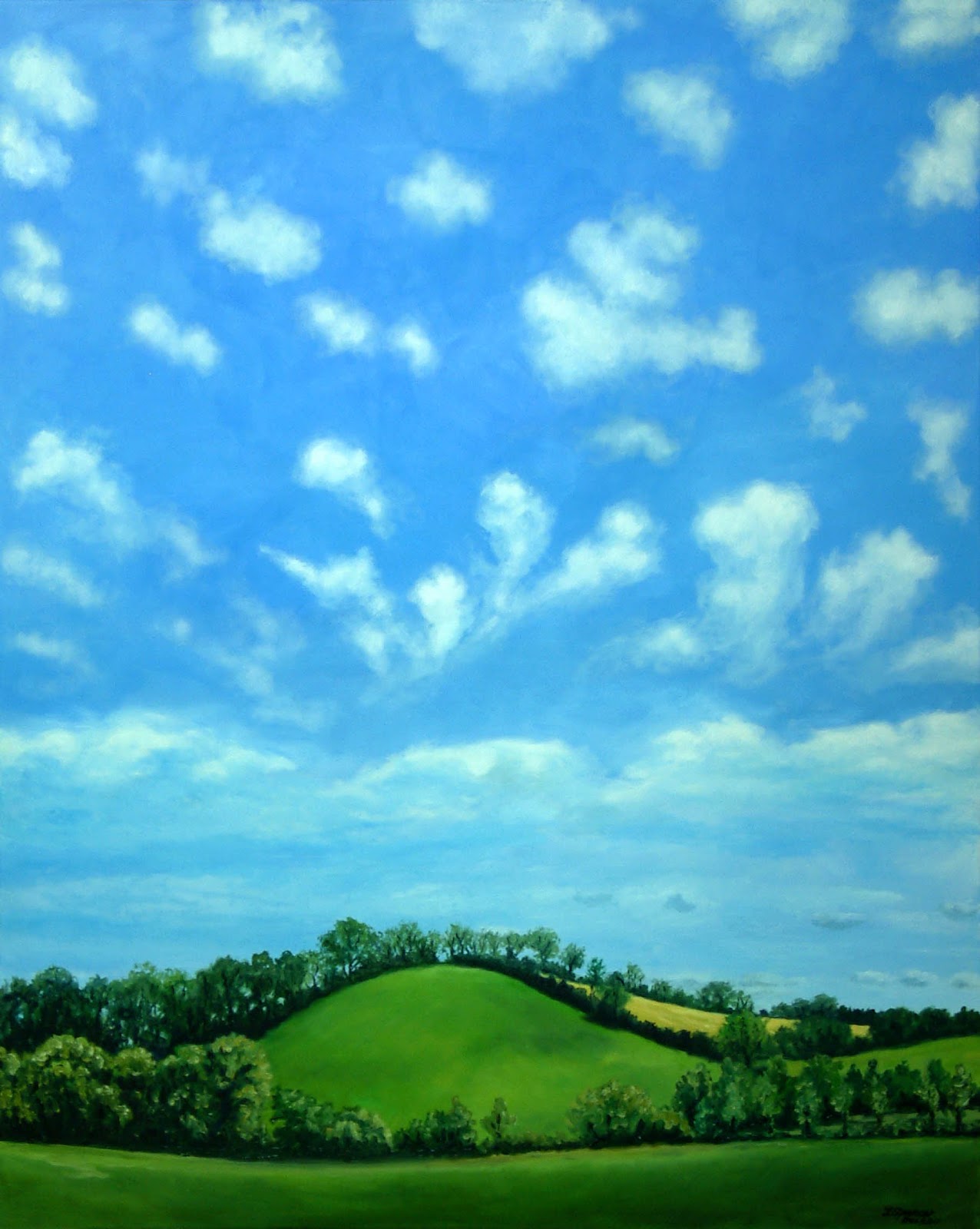
"Drumlin Skyscape", December 2011
Oils on canvas, 101.5cm x 81cm

I have always loved the rounded shapes of the local hills (drumlins), having grown up surrounded by them. In many ways, the landscape in the painting is very typical of County Down; the drumlin itself, the small fields, the rich greens. But in addition I wanted to create the feeling of the sky extending over the hill and above the viewer. Hence the title of "Drumlin Skyscape".

There are many reasons for creating paintings. But, for me, each one acts as a window and sometimes as a door. As a window, a painting allows the spectator to look inside the mind and imagination of the artist and, more importantly, if they can relate to it themselves then it allows them to look inside their own mind and memories. But sometimes a painting can also act as a door. By this I mean that a spectator can relate to the painting so intensely that it acts as a means of stepping through to another world of experience, leaving them emotionally in a different place to where they were before.

Wednesday, August 17, 2011

Market Square, Lisburn

"Market Square, Lisburn", August 2011.
Oils on canvas,  61 cm x 45.5 cm

Just finished this painting. The Island Arts Centre in Lisburn has invited submissions for an exhibition, so I thought I would try for it with a scene of local interest. Apparently, the city is building up a permanent Collection, linked to The Anna Cheyne Visual Award. But even if they do not purchase my painting, there will be an exhibition of as many of the submissions as they have room for, so there is a good chance it will be exhibited at least.

Thursday, July 21, 2011

Fauvist leanings


This is an early painting of mine, from 1974 when I was in my first year of my B.A. course at Art College. At the time I was having considerable difficulties with the head tutor of the first year students, who did not like my work and seemed incapable of understanding three-point perspective (where the picture plane is tilted either downwards or upwards). My interest in this painting was primarily in investigating how the diverging vertical lines created the sensation of looking downwards into the painting. I deliberately shaped the edges of the canvas to match the perspective (although in later work I found that slanting the edges in the opposite way actually enhanced the perspective effects more).

However, a secondary interest was in the use of colour, the colours becoming naturally exaggerated as I concentrated on noticing the minor variations of shades. What I did not realise at the time, pre-occupied as I was with the perspective and my tutor difficulties, was that there is a strong connection with what I was doing and some Fauvist work. For example, several of André Derain's paintings, notably “London Bridge, winter 1906”, incorporate a wide angle of view, including some perspective effects created by the spectator looking downwards. However, the colouring of the French Fauvist work is generally so extreme that I think that was what prevented me from making the connection at the time. More recently, I encountered the work of some of the Belgian Fauvists, such as that by Willem Paerels and Rik Wouters, where the control of colour is much closer to that which would interest me.

I do not believe that it would be correct to say that my concept of Experiential Realism was influenced by Fauvism. It is more that I recognise some common concerns, for example, recording perspective as experienced, rather than as required by formal rules. Also that my colour, whilst not as intense as that of the Fauvists, nevertheless becomes intensified through the process of concentrated observation.

Sunday, January 25, 2009

Moving into a new studio

First day with bare walls and floor!


My first blog in quite a long time! Things have been very busy for me and I have been finding it increasingly difficult to get on with my own work without having a proper – and permanent – space to paint in. So I decided that it was time to rent a proper studio! Studio 23 is an artist’s collective and I came across them when they ran a “Salon des Refusés” for work not accepted by the Royal Ulster Academy. I liked the setup and, as a new set of studio spaces were becoming available, decided that it I should take one of them. I started to move in two weeks ago. Very bare and uninviting at first! But since then, I have got the walls covered and I put picture rail around the top to make it easier for me to hang pictures and to vary their positions. The spaces were actually created by dividing up a large warehouse and so there is no ceiling, as such, to the studio. This means that, without further measures, it is almost impossible to heat! I have now put a “ceiling” of clear plastic over the top, supported by a grid of fishing line underneath. It still lets in the light but traps the heat. I am now very comfortable!

No ceiling yet, but getting there!

Since moving in, I have only just started to work. But I am very optimistic that being in the studio will help my art to develop better. It makes such a difference being in a place where there will be no interruptions, surrounded by your own work and being able to completely concentrate on painting! Hopefully, in the future I will have more to report on what I am doing, so I hope to get back to blogging regularly.

Sunday, March 23, 2008

A bit more towards a General Manifesto of Experiential Realism

Making up a personal Manifesto is dead easy! All you really have to do is list your likes and dislikes! Making up a General Manifesto is much trickier as you really have to think about what the words mean.

Take the word "Realism", for a start. Realism links up with previous Realist art movements. According to Wikipedia, "Realism is a visual art style that depicts the actuality of what the eyes can see. Realists render everyday characters, situations, dilemmas, and objects, all in verisimiltude. They tend to discard theatrical drama, lofty subjects and classical forms in favor of commonplace themes." It also states, "Gustave Courbet is credited with coining the term, which pins "Realism" (capital R) down to the 19th century. However, realism (without the capital) links with "realistic", which now links up with every artist who as ever depicted something which looks like the "real" world! And this is far too broad a definition to be useful.

"Realism is a visual art style that depicts the actuality of what the eyes can see."
This, at least, is of some use. The advantage here is that when the content of the picture depicts - or appears to depict - the real world, the the artist is using a visual language with which most people are familiar. It makes the artwork instantly accessible to the majority of people, not just a few, specialist, "art trained" connoisseurs. I want my work to be accessible to the majority, not just a tiny proportion of the population. So I can use this to make up a clause:

"Experiential Realism depicts the actuality of what the eyes can see."

However, note the use of the word "depicts". An artist uses paint, reality uses real light, real trees, real grass, etc. So an artist has to use his skill and knowledge of his medium to persuade the viewer that what he is painting really exists. I would go slightly further. If an artist paints an apple and the viewer sees a painting of an apple, then the artist has failed. When the viewer looks at the picture and sees an apple, then the artist has succeeded! The medium is not the message, merely the means of transmitting it.

So I think that the clause can become:
"The Experiential Realist artist uses their skill to represent the actuality of what the eyes can see."

The Realist art movement of the 19th century also links up with a number of other "Realisms", which are worth looking at as part of a general search for enlightenment. Note, "Realists render everyday characters, situations, dilemmas, and objects, all in verisimiltude." This is something I have a lot of sympathy with. It also links up with "Social Realism" and "Socialist Realism" (which was more specifically linked to Communism). However, both Social and Socialist Realism were linked to particular political aims and ideals. For my own part, in depicting everday places and events I have no motive other than I think that they are worth celebrating. So if I was to use this part of the definition of Realism as another clause, I think that it must become:

"The Experiential Realist renders everyday places, characters, situations, dilemmas, and objects, all in verisimilitude, as being of interest and importance."

Note that this definition does not exclude the painter of the natural landscape. I enjoy - occasionally - the world of nature. But as a painter, I am more more interested in the way that people interact with their environment! That is just my personal bias, so it has no part in a general definition.

"They (Realists) tend to discard theatrical drama, lofty subjects and classical forms in favor of commonplace themes." Classical Realism is a late 20th century art movement which placed "a high value upon skill and beauty, combining elements of 19th century neoclassicism and realism. My problem with this movement is not that I decry skill, but that the classical style makes you too aware of it. Hence the skill, rather than the subject, becomes the message. It is the same problem as the one that I have with Photorealism. Also the "high value" placed on "beauty" means, to my mind, the acceptance of pre-existing ideals of beauty. I want to challenge the viewer to see beauty where they might not always have previously considered it to exist, frequently in the ordinary and mundane. So it might be fair to add the following:

"The Experiential Realist finds and depicts beauty through their own experience."

Another art movement worth considering is "Magic Realism". In some ways, René Magritte is a good representative of this style. The paintings are incredibly realistic - at least, at first glance - but then involve surrealist/magical/mystical elements. The bit which I find useful is the notion of a mystical or transcendental element. I do not feel any need to introduce incongruous elements into my paintings of the Experiential Realist type. For me, the magic is in my own awareness of the original scene or situation and in my attempt to transmit this to the viewer. But I am not sure that, as yet, I can define a clause to properly express this! However, perhaps it is possible to say that:

"The Experiential Realist allows their awareness of the situation and circumstances of the subject to influence their perceptions and the way that they expresses them."

By this I mean the sort of thing that I wrote about some time ago, in my blog, " Thinking about Painting", the manner in which we "scan" a scene, focusing on different things at different times. Things that we pay particular attention to can appear brighter and sharper, etc.

In all, I appear to have ended up with four clauses for the General Manifesto that I think I can stand by:

The Experiential Realist:
  • Uses their skill to represent the actuality of what the eyes can see.
  • Renders everyday places, characters, situations, dilemmas, and objects, all in verisimilitude, as being of interest and importance.
  • Finds and depicts beauty (and ugliness) through their own experience.
  • Allows their awareness of the situation and circumstances of the subject to influence their perceptions and the way that they expresses them.
Of these, it is the first two that make a direct connection with Realism. However, I think that it is the last two which tend to mark the difference between Experiential Realism and pure Realism.

Sunday, March 16, 2008

Towards a General Manifesto of Experiential Realism

I was reasonably happy with what I wrote last week as a Manifesto for Experiential Realism. Later, however, I realised that, although it reflected my own views, it would not do as a General Manifesto - which would include other artists who think the title of “Experiential Realism” sums up something important about the way that they work. This was prompted by my making a search for the term on the Internet. I already knew that the term was being used in philosophy, as that was where I adopted it from as the name, potentially, for an art movement! However, I also discovered that a couple of American artists had spontaneously used the term with reference to their own work. An American artist, Aaron Schuerr, used it as a title for one of his blogs and another American, Dough Rugh, used it as a descriptive term within another blog. I cannot be certain that either would agree with the way I think about it, but it seems to me to be worth considering in greater detail my own understanding of what “Experiential Realism” means.

In order to do this, I am going to start with what I have already written, expand and clarify it, as best I can. It is, perhaps, easiest to start with the negatives. I wrote:

I reject:

  • Art as decoration, as wallpaper.
    I remember watching an interior decoration programme, I think that it was called “60 Minute Makeover”. The team needed something to add a splash of colour to a wall, something which would match the furniture and the rest of the colour scheme. Someone took a blank canvas, splashed some paint on it to form an abstract pattern and, voilà, instant piece of Abstract Expressionism - which matched the wall perfectly! This may be rather an extreme example, but a lot of people do buy art because it will match in with their décor. It may be rather arrogant of me, but I want more for my art than that!

  • The possession of art as a means of establishing intellectual status.
    I am not opposed to the various other movements of modern art, such as Conceptual Art, Minimal Art, Post-Modernism, etc., as such. However, I am left with the uncomfortable feeling (hopefully untrue) that many of the purchasers of such work do so to establish, at least in their own minds, their status as intellectual beings, capable of the superior aesthetic understanding required to appreciate such work. I believe that the only genuine reason for purchasing art should be the depth of the feeling that the piece evokes in the prospective purchaser. Provided that such depth of response is present, the type of the artwork is immaterial.

  • The Media as the Message and The display of skill as the purpose of art.
    In the end, I decided to lump these two together. I suppose that I was very much thinking of the Photo-Realist and Super-Realist art movements. There is a good example by Richard Estes online.
    “Diner”, (1971) Oil on canvas, 40 1/8 x 50 in. (101.7 x 126.8 cm.) It is of course, beautifully painted! But I find myself asking, what would be the difference between this and a photograph produced to the same scale (if one such a photograph existed)? It does not seem there could not be that much difference, since the apparent object was to paint in a photographic manner. Therefore the value of the painting – as art – had to be in the fact that the medium was changed from photography to painting. In other words, this was the painting skill itself being presented as art. It could also be said that, in this case, the media, paint, was the message. Looking at the painting, I do not find myself interested in the place represented, so much as the means by which it represented! I am distracted by the quality of the painting!

  • The idea as art.
    Essentially, this is Conceptual Art, but also the work of artists like Damien Hirst. I would consider his diamond covered skull, titled “For the Love of God” to be in the same vein as the Dadist Marcel Duchamp's “Fountain”. Duchamp's piece was a ready-made urinal which he elevated to art by signing it “R. Mutt”. Damien Hirst's skull was a ready made skull, which he elevated to art by having it covered in diamonds! Duchamp mocked the establishment by the cheapness, in both price and effort, of his “readymade”, Damien Hirst mocks it by intrinsic value of the diamonds with which he decorates his own “ready made”. Duchamp was outside the Art Establishment looking in, Damien Hirst is inside the Art Establishment looking out. In some ways, complete opposites, but on the same line! However, the most important part of both items is the idea behind them.

  • Other people's conventions of beauty and ugliness.
    I think that a large part of the value of any creative person is their individual viewpoint. So what I mean by this is that every artist has to find out for themselves what they consider to be beautiful or ugly. Truly original work makes new conventions, rather than simply repeats old ones.

I have one major problem with all the points that I have listed above (even though I believe them to be valid) – and that is their very negativity! In the end, I think that it is more important to know what an Art Movement is for, rather than what it is against. So I hope to explore this next week.

Sunday, February 18, 2007

"Experiential Realism" as a modern Art Movement

I have been looking for an art term or title that describes what I am trying to do. The best that I have been able to come up with is, "Experiential Realism". The term already exists in philosophy as developed by George Lakoff, of the University of California at Berkeley.

In philosophical terms, Experiential Realism accepts the existence of the real world and that its nature determines much of how it is understood. But the philosophy also reasons that our understanding of the world develops from the nature of our own bodies and our upbringing. For example, (if I understand this correctly) if people from two different cultures looked at a tree, they would both be able to accept its reality, but at the same time - influenced by different cultural attitudes and personal experiences - they would also perceive it somewhat differently.

In art terms, Realism was a late 19th century art movement which was concerned with the accurate and apparently objective description of the ordinary, observable world. The Realists attempted to depict the lives and appearance of ordinary people. Social Realism developed from this, in the early 20th century, as a movement particularly concerned with depiction of the poor and thus it criticised the social environment that caused the poverty and misery. Essentially, whatever their value as works of art, Social Realism was a form of propaganda endeavouring to change social attitudes. The original Realists were also propagating a view, although a rather simpler one, that the lives of ordinary people were just as suitable a subject for major works of art as the lives of the rich and powerful.

Both were reactions to prevailing viewpoints, as is my own. My point is that the realistic depiction of every day life and places is still worthy of depiction in serious works of art. It is not simply the domain of the hobbyist and the part-time painter. And has certainly not been made defunct by the advent of photography! However, I think that such painting has to rise above mere mechanical recording, which is why I prefer the term, "Experiential Realism", as referring to my type of art. My depictions are influenced by my experience of the scene and this is determined by both my physical and mental characteristics.