Showing posts with label Ulster. Show all posts

Sunday, March 29, 2015

My most recent paintings!

"Small Skyscape 7", March 2015.
Oils on canvas, 40.5cm x 50.5cm.

"Small Skyscape 6", March 2015, T. Spencer.
Oils on canvas, 40cm x 50.5cm.

"Snowy Slieve Croob Skyscape", February 2015.
Oils on canvas, 49.5cm x 70cm.

"Misty Sunset Skyscape", February 2015.
Oils on canvas, 45cm x 63cm.

"Skyscape near Comber, Co. Down", January 2015.
Oils on canvas, 49.5cm x 69.5cm.

"Mourne View Sunset", January 2015.
Oils on canvas, 49.5cm x 69.5cm.

"Small Skyscape 5", Dec. 2014.
Oils on canvas, 25.5cm x 30.5cm.

Sunday, November 23, 2014

It can take a long time to do a painting!

"View of the Mournes from the Dromara Road, near Ballynahinch, County Down, Northern Ireland", 2014.
Oils on canvas, 50 cm x 70 cm.


The painting was actually started in 2007, when I completed the sky and basic layout. Then I got stuck and left it, just returning to it in the last month. As often happens with me - after I have left it long enough - the final stage is quite straightforward!

Sunday, January 01, 2012

Windows and doors!

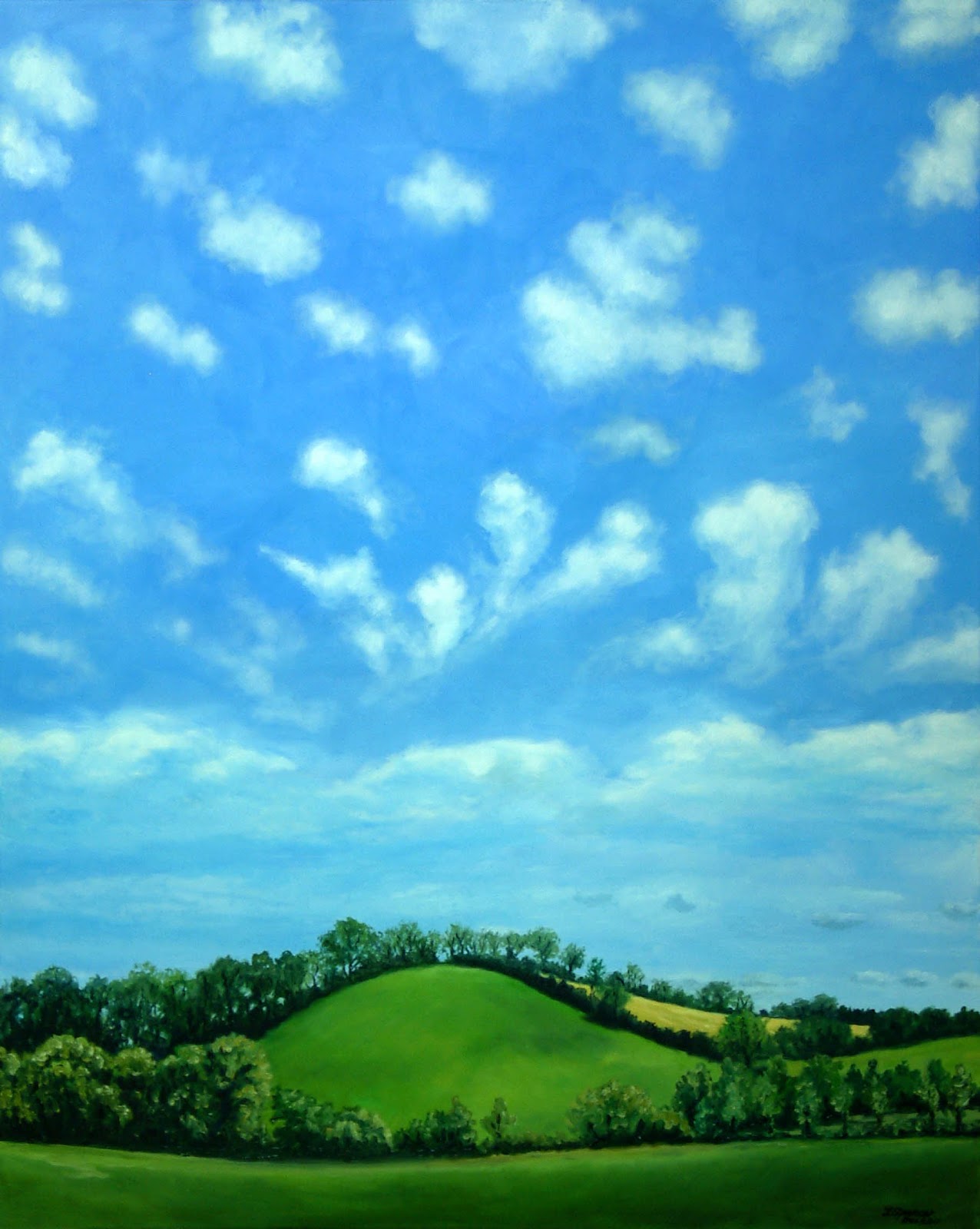
"Drumlin Skyscape", December 2011
Oils on canvas, 101.5cm x 81cm

I have always loved the rounded shapes of the local hills (drumlins), having grown up surrounded by them. In many ways, the landscape in the painting is very typical of County Down; the drumlin itself, the small fields, the rich greens. But in addition I wanted to create the feeling of the sky extending over the hill and above the viewer. Hence the title of "Drumlin Skyscape".

There are many reasons for creating paintings. But, for me, each one acts as a window and sometimes as a door. As a window, a painting allows the spectator to look inside the mind and imagination of the artist and, more importantly, if they can relate to it themselves then it allows them to look inside their own mind and memories. But sometimes a painting can also act as a door. By this I mean that a spectator can relate to the painting so intensely that it acts as a means of stepping through to another world of experience, leaving them emotionally in a different place to where they were before.

Wednesday, October 26, 2011

Skyscape


“Slieve Croob Skyscape”, October 2011.
Oils on canvas, 101.5 cm x 81 cm.

This is quite a large painting. The intention is to draw your view into looking at the mountain, but leaving you with the sensation of the sky over your head.

Saturday, March 08, 2008

My Art - A Personal Manifesto for Experiential Realism

"Quoile River, near Downpatrick"
December 2007-February 2008.
Oils on canvas, 70 cm x 50 cm.

For some time I have been trying to form my own ideas about the “why” of art, the role of art in today's world. Then I realised that this was far too big a question for me, since art covers such a multitude of activities and fulfils an important role in such varied circumstances. In the end, I decided that the question I needed to answer was, “Why my art?” What is it that I am trying to do, what is it that I think of as being important and what do I reject.

In a previous attempt (18th, February, 2007, to be exact) to understand my own art, I considered the way we look at things. We do not see objects and scenes in the rigid way that a camera records them. We move our heads (and we have two eyes, giving us stereo vision, which means that sometimes one eye can see what the other can not), our eyes can appreciate a much greater range of colours and shades than a camera normally records and we look at different parts at different times, mentally blending our observations into the one perception.

Although not intentionally distorting what I am seeing, when painting I quite automatically incorporate this way of viewing into the result. Perspective - whilst appearing to be essentially correct - will be "adapted" so that vertical lines may no longer be precisely vertical, angles may change to make the view more dramatic or to reveal a greater area (as from a different viewing point). One of the rules of human observation is that one "notices" more that which one is interested in, so colours can appear more vivid and objects larger! Everything one is interested in is in focus because one automatically focuses on the part which is being observed. Based on this, I have named the way I work as “Experiential Realism”, meaning that the realism of the painting is tempered and modified by the way that I experience the scene.

The result of this thinking is:

A Personal Manifesto for Experiential Realism

I reject:
  • Art as decoration, as wallpaper.
  • The possession of art as a means of establishing intellectual status.
  • The media as the message.
  • The display of skill as the purpose of art.
  • The idea as art.
  • Other people's conventions of beauty and ugliness.

I embrace:

  • Art as the conveyor of meaning.
  • Art as a stimulus to feeling and emotion.
  • The use of the illusion of depth in painting.
  • Depth of meaning in art.
  • Art as a teller of stories.
  • The beauty that I perceive and experience, without reference to the strictures of others.
  • I embrace the beauty of the ordinary, the every-day activities of people in their everyday surroundings, the beauty of the ordinary street, the ordinary house, the ordinary shop.
  • I embrace the portrayal of landscape as it is, part natural, part man-made.
  • I embrace the portrayal of the world of today as it is, a mixture of old and new.

Thomas Spencer.

Historical Comment:

In art history, Realism was a late 19th century art movement which was concerned with the accurate and apparently objective description of the ordinary, observable world. The Realists attempted to depict the lives and appearance of ordinary people. Social Realism developed from this, in the early 20th century, as a movement particularly concerned with depiction of the poor and thus it criticised the social environment that caused the poverty and misery. Essentially, whatever their value as works of art, Social Realism was a form of propaganda endeavouring to change social attitudes. The original Realists were also propagating a view, although a rather simpler one, that the lives of ordinary people were just as suitable a subject for major works of art as the lives of the rich and powerful.

Both were reactions to prevailing viewpoints, as is my own. My point is that the realistic depiction of every day life and places is still worthy of depiction in serious works of art. It is not simply the domain of the hobbyist and the part-time painter. And has certainly not been made defunct by the advent of photography! However, I think that such painting has to rise above mere mechanical recording, which is why I prefer the term, "Experiential Realism", as referring to my type of art. My depictions are influenced by my experience of the scene and this is determined by both my physical and mental characteristics.

Nb: This Manifesto should not be taken as meaning that I consider other types of art as necessarily unimportant and unable to fulfil important functions – or even that I cannot appreciate them! Just that they are not important to me, within the context of my own work and intentions.

Thursday, February 14, 2008

Downpatrick Exhibition


The exhibition in the Downpatrick Library Gallery opened last Wednesday (6th February) night. It is in support of the Harmony Community Trust, Glebe House, Strangford, and was opened by one of the local politicians, Margaret Ritchie of the SDLP. It went well, but I was a bit disappointed with the attendance, only about thirty or so. However, two of my five paintings are sold, so that is a start. It is a good exhibition space, basically one large, well-lit room, at one side of Downpatrick Library. Hopefully, because of its position next to the library, this will help there to be a reasonable number of further visitors.


Because of the need to get my paintings ready in time, I went for producing five small landscapes. They were quite successful (and I am pleased with them), but the exhibition made me aware of how many others are producing work in a similar format. I think that I need the larger formats in order to stand out. Also, paintings of towns and buildings are relatively rare, so I think that my paintings of town scenes also stand out for that reason.

The more that I see work of local artists, the more convinced I become that the truly memorable work is nothing to do with either skill or technique. It seems to me that most of the work which has reached the history books has done so because it encapsulated something personal about the artist's life and times. Much of the work I see is attractive, some of it is highly skilled, but I am not convinced that it rises above the decorative. It is not that I am knocking decorative work as such, but I feel the need for something more.

For more photos, see ArtMagic; Downpatrick Exhibition.

Sunday, January 20, 2008

Two new landscape paintings.

"Corner on the Newcastle to Ballynahinch Road",
December 2007.
Oils on canvas, 25 cm x 30 cm. (11 hours working time)

There is a small, local exhibition coming up and I agreed to submit five paintings. Just got the last two finished, to my relief! There are, I think, quite nice, although not what I would consider major paintings. The weather has been poor recently and does not encourage much work outdoors. I am very much looking forward to warmer weather, when I can start spending much longer outside working on paintings.

I have quite a few paintings I want to get finished. At the beginning of January we had - for us - heavy snow (i.e., about 16 cm, which fell in the one night and lasted about a day). As always, it caught us unprepared. My wife and I were travelling to Ballynahinch and were about 15 miles away from there when it started. So, naturally, when we were just a few miles from Ballynahinch we got stuck (with a lot of others) at the first serious hill. It was only when some of us drivers got together to give cars a push that we were able to get moving again. No chance of help from the police or the road service as they were all snarled up around the town itself, nobody able to move on any of the roads leading in or out of Ballynahinch. The one good thing about being stuck where we were was that when, after several hours, we got moving again, at least the traffic chaos in Ballynahinch itself was beginning to clear and we were able to get to our destination! The other good thing was that the snow was still there in the morning, so I took several canvases up into the town and was able to sketch layouts on to them. I think that I should, potentially, have a couple of good paintings, although they will have to be completed from the photographs that I took at the time.

"Horses in a Field", December 2007.
Oils on canvas, 30 cm x 25 cm. (14.5 hours working time)

Sunday, December 09, 2007

Pricing one's artwork.

"Drumlins, Near Ballynahinch, Co. Down, N. Ireland", November 2007.
Oils on canvas, 30.5 cm x 25.5 cm. (6 hours working time).
£120 unframed, plus postage and packing.
Pricing one's artwork:

This is not an attempt at advising others on how they can price their own work, just my own musings on the subject, with an invitation to others to comment.

It seems to me that this is always going to be a thorny subject. Price yourself too high and you are unlikely to find buyers. Too low, and, effectively, you end up subsidising your buyers. You can, therefore, only continue to produce artwork if you have other means of support. This also makes it difficult to raise your prices in the future because you have firmly set yourself in the bracket of amateur artist. Of course, one way out of this dilemma is to find a dealer who likes your work sufficiently to promote it, but this has the disadvantage of meaning that you have to be able to fit into a recognised slot in the art market.

My own case is slightly peculiar. Because I taught art for many years, my skills and knowledge of the subject are quite highly developed. However, because I was concentrating on my teaching career, I have built no reputation for myself as a professional artist and established no slot for myself in the art market. Indeed, on leaving teaching, my morale was so low that, at first, I had difficulty in believing that anyone would be interested in anything that I might produce!

Because I have a pension, I do not rely on selling my art to cover basic living expenses. However, as a mature person with commitments, neither can I completely devote every moment of my time to my art career. Essentially, the two aspects balance each other out. My pension covers my non-art commitments, but my art work has to sustain, through sales, my ability to produce more art work and to develop my career as an artist. I also have no desire to subsidise my buyers. If my work is worth buying, then it is worth the buyers paying a realistic price for it!

I decide that, as an entry level-artist, without an established reputation, that the best initial policy was to price myself as a skilled and professional craftsman. However, I also had to allow that non-commissioned work, which might not sell immediately, would involve marketing expenses which also had to be covered. I therefore decided to that the price of my art work would be calculated according to how long each piece took to be produced, at a basic rate of £20 per hour. Since commissioned work brings in cash as soon as it is completed, I give a discount of one third on all commissions.

This is not great money, but it has been adequate to allow me to establish a local reputation - which is keeping me busy with a steady flow of commissions. This , in turn, has meant that I have started to build up a reserve of non-commissioned work for sale at exhibitions. For the immediate future, commissions take priority, because these are what allow me to keep going. For the longer term future, the non-commissioned work is vital, because these will allow me to establish both a wider reputation and higher prices.

From a pricing point of view, non-commissioned work can be split into two categories. Relatively quick work, such as small landscapes and people studies (which therefore carry relatively low prices) and more elaborate and impressive pieces, such larger landscapes and studies of towns (which are time-consuming and thus have to carry larger prices). Landscapes have proved popular in the local market and, as they carry the full price tag, are more profitable - providing I can wait for the financial return! Larger, more elaborate pieces, have to sell between £1,400 and £2,000 if, even on my present pricing system, they are to be worth doing. Since a smaller percentage of the population is prepared to pay this sort of money, this means that I have to gradually become better known to attract the right sort of buyers. However, by their nature, the larger pieces are more impressive so, eventually, this should happen.

There are limits on how much work that I can produce so. hopefully, a point will be reached when I cannot fulfil the demand (to a small degree, this is already happening). This means that I can afford to discourage some buyers by asking for higher prices. If I am getting higher prices, than the value of existing pieces is also likely to go up and so my work should acquire an investment value, which in turn should boost sales. This is clearly a delicate balance, but the big advantage - to me - of higher prices is that it gives me more freedom to select the sort of work I want to do and to experiment with other media (for example, I have planned some pieces of sculpture that I would like to be able to cast in bronze). Greater financial freedom should also bring me more freedom in terms of where I can exhibit and thus widen my potential market.

All of this is calculated entirely from the point of view of the money required by me, personally, in order to be able to continue to produce work and expand my own art career. However, a time should come when established, commercial art galleries find my work desirable purely from a business point of view. The difficulty with this is that galleries have to factor in their own profit margins, so an increased selling price will not necessarily immediately reflect in more money for myself. What would make this worthwhile would be if the gallery was promoting my work into new markets and could reach further afield. It would also lift the burden from me of having to organise my own exhibitions! In the longest term, this is probably the way that my career has to go, since eventually it would result in the greatest freedom to concentrate on producing the work I want to. However, it is not something that I am feel any urgency about. Galleries have their own concerns! If they see a profit in promoting my work, I think that this will make them keenest to do so!

From an artistic point of view, I am happy with what I am doing. I know my work to be unique and I believe that it offers something special to the various people who have bought my paintings. I just want the financial freedom to be able continue expanding the scope of my art. The above writing encapsulates my thoughts on how I can establish this greater financial freedom. If anyone reading this is also a working artist, I am would be interested in their comments and curious as to their own approach(s) to promoting and financing their careers.

Sunday, October 14, 2007

Preview Night


The Preview of my Art Exhibition was held on Thursday, 11th October. It went very well, approximately 20% sales on the night, but more important was the feedback I got (very encouraging) and the general "buzz" (which was excellent). I also got several commissions for new work. All in all, a very successful night!

Saturday, October 06, 2007

My Art Exhibition


I have been very busy this last couple of weeks. I am putting an exhibition of my art work for the last eighteen months. Hard work, but also quite good fun.

On Thursday, a photographer from one of the local papers came to get some photos for an article on the exhibition! I have put up posters around the town and, of course, a lot of individualised invitations have been sent out, but getting the local press onboard is likely to be critical to the success of the show.

Saturday, February 10, 2007

Slieve Croob sunset, Co. Down, N. Ireland

“Slieve Croob at sunset, from the Saintfield Road, Ballynahinch."
Oils on canvas, 20” x 30”.

It has been awhile since my last post, but I have been thinking a lot about what I am trying to do with my painting. In one sense, my aim is completely straightforward, I am trying to record what I see as "realistically" as I can. But the realism is the one of my perception and experience of the scene, not as a camera would record it. The above example illustrates the point. I decided to create this painting after seeing the sunset from this spot whilst driving between Bangor and Ballynahinch. I took photographs to assist - but these could not actually record the play of light the way I was seeing it. If I photographed the sky, the ground was under-exposed, and even if I allowed for this so as to photograph the land, the contrast was still too great between parts which were illuminated by the setting sun and the areas of shadow. However, I could see details within the shadow, the highlit areas and the sky as I scanned the scene. Hence my experience of the scene was as a whole.

I started the painting by, as is my custom, sketching in the composition from observation - but under normal lighting conditions. Some of the filling in was then done with the assistance of photographs - but modified by my memories of the scene. When a similar sunset occurred, I returned to the site to attempt to check details from observation - but I found that the way the light fell on the canvas was so extreme that it largely made this impossible. In the end, I simply used the experience to refresh my memory of the colours and shading and then completed the painting in the studio.

In fact, I am very pleased with the result. I believe that it portrays the "truth" of my experience of the sunset in a way that is impossible for photography to do.

Saturday, October 07, 2006

Latest paintings!

I have been rather busy since my last blog, so this is primarily an exercise in displaying my latest paintings! They are all on 24 x 18 inch canvases, as I find this a very convenient size to work with. I am continuing to get requests to do paintings, but it is going to be more difficult to work from observation now that winter is approaching. For one of the paintings that I am working on at the moment, I found that I had to work from the back seat of my car, parked on the opposite side of the street from the building which is my subject. I have a variety of lightweight shelters (the most useful of which is a large fisherman's umbrella), which can cope with rain quite well - but not when combined with strong gusts of wind!

“Charles’ Papershop, Ballynahinch”, September 2006.

“Market House, Ballynahinch”, September 2006.

This last one was a commission from the Ballynahinch Regeneration Committee.

“Ginesis CafĂ©, Main Street, Ballynahinch”, August 2006.

Sunday, August 13, 2006

Thinking about painting!

“38 Main Street, Ballynahinch”, July 2006.
Oils on canvas, 24” x 18”.


I have been doing a lot of thinking about the "why?" of what I am doing. Initially, when I started painting again, it was simply to get myself, without stress, back into the habit of working on my own art. But, as I became involved with the mechanics of what I was doing, it became clear that straightforward "observational" painting is really not either straightforward or simply to do with observation!

A normal photograph of a scene will do three main things:
  1. It will record the scene with strict regard to linear and aerial perspective - the view is recorded from one precise point, straight lines will appear straight, objects will diminish in size with mathematical precision according to distance and more distant objects will appear to be hazier and bluer.
  2. Colours, because of the limitations of film design (or printing ink, if using a digital camera) will be be distorted. Some colours, usually the most vivid, will "out of gamut" and cannot be reproduced exactly - and so will be muted.
  3. There will be variation according to the depth of field. Anything at the same distance as the object focused upon will appear to be sharp. everything in front or behind will appear to be blurred. (By using a very small depth of field, a photographer can deliberately use this to isolate his subject from the background, so that his subject appears sharp and everything else will appear hazy.)
But this is not actually the way that a scene is viewed in reality. We move our heads (and we have two eyes, giving us stereo vision, which means that sometimes one eye can see what the other can not), our eyes can appreciate a much greater colour range than the camera can record and we look at different parts at different times, mentally blending our observations into the one perception.
Although not intentionally distorting what I am seeing, when painting, I quite automatically incorporate this way of viewing into the result. Perspective - whilst appearing to be essentially correct - will be "adapted" so that vertical lines may no longer be precisely vertical, angles may change to make the view more dramatic or to reveal a greater area (as from a different viewing point). One of the rules of human observation is that one "notices" more that which one is interested in. So colours can appear more vivid - and the perceptions can then be reproduced by using the full range provided by good quality paints! Everything is painted in focus because one automatically focuses on the part which is being observed.
The final result of all these adaptations is that, I believe, a painting can be much more "alive" and truer to actual perceptions of a scene than a photograph can ever be!

“Kitties Entry (Harmony Way), off Main Street, Ballynahinch”, July 2006.
Oils on canvas, 24” x 18”.

Saturday, July 29, 2006

The start of my Ballynahinch Art Project.

A couple of months ago, after leaving teaching, I decided that I needed to get back to my own art work. Since I was spending a lot of time in Ballynahinch (Co. Down, N. Ireland) I decided to create a series of drawing and paintings about the town, working from life.

My first painting was only a quick study in oils on canvas, completed in an afternoon, a view along High Street towards Dromore Street. However, the response to my working in the street, even for such a quick study, was very encouraging.

My next painting was a view along Main Street. The big shock here was that it was bought by someone, as a present, before it was even finished! In addition, I got a commission for another painting whilst I was working on this one.


“Main Street, Ballynahinch”, June 2006.
Oils on canvas, 30” x 20”.


“Stewart & Gibson, Main Street, Ballynahinch”, June 2006.
Oils on canvas, 24” x 18”.